Curriculum at Sixth Form
At Gillingham School Sixth Form, our curriculum is designed to foster academic excellence, personal growth, and preparation for life beyond school. To cultivate the knowledge, skills, and character needed for all students, regardless of background, to access ambitious and rewarding higher education opportunities, apprenticeships, or careers. Once registered to enrol in our Sixth Form you will be provided with option blocks to select your subject’s of study.
We aim to ensure that every student leaves us not only with excellent qualifications, but also with a strong sense of self, a commitment to community, and the confidence to pursue ambitious and fulfilling futures. Whether progressing to university, apprenticeships, or employment, our students are equipped to succeed and to contribute meaningfully to society.
We offer a rich and holistic curriculum that combines academic rigour with a wide-ranging enrichment and personal development programme. Running throughout the curriculum is a commitment to:
- High-quality careers education, advice, and guidance
- The development of leadership skills
- A clear understanding of our shared values and social responsibilities within our school and wider community
Our curriculum reflects and reinforces the values of ambition, kindness, resilience, and respect—values which underpin our whole school community.
Year 12
- To join the Sixth Form, students need five or more GCSE grades at 4 or above
- Most students study a programme of three Level 3 subjects, selected with guidance and tailored to their strengths and aspirations
- Some students may opt to study four Level 3 subjects. To do so they must have an average GCSE score of 7+
- Students are encouraged to undertake a complementary course in Core Maths or an Extended Project Qualification (EPQ) to support career progression and applications for future pathways.
- Study periods are used for supervised, independent learning. All students will have 9 study periods over the two-week timetable allocated to their timetable.
- Internal assessments in June inform decisions about progression into Year 13
- Students engage in our enrichment and personal development programmes to become well-rounded individuals, equipped with essential skills such as communication, teamwork, independence, and resilience. These programmes also promote civic responsibility and active community engagement.
Year 13
- Most students continue with their strongest three A Level subjects, based on performance and future plans.
- A small number may continue with four A Levels, where appropriate.
- Students continue to benefit from Wednesday Afternoon Enrichment opportunities, while leadership roles become optional.
- Each A Level subject is allocated 6 x 60-minute lessons per week in Year 12 and 5 x 60-minute lessons in Year 13.
- Additional timetabled lessons include EPQ or Core Maths, Future Routes, and Wednesday Afternoon Enrichment.
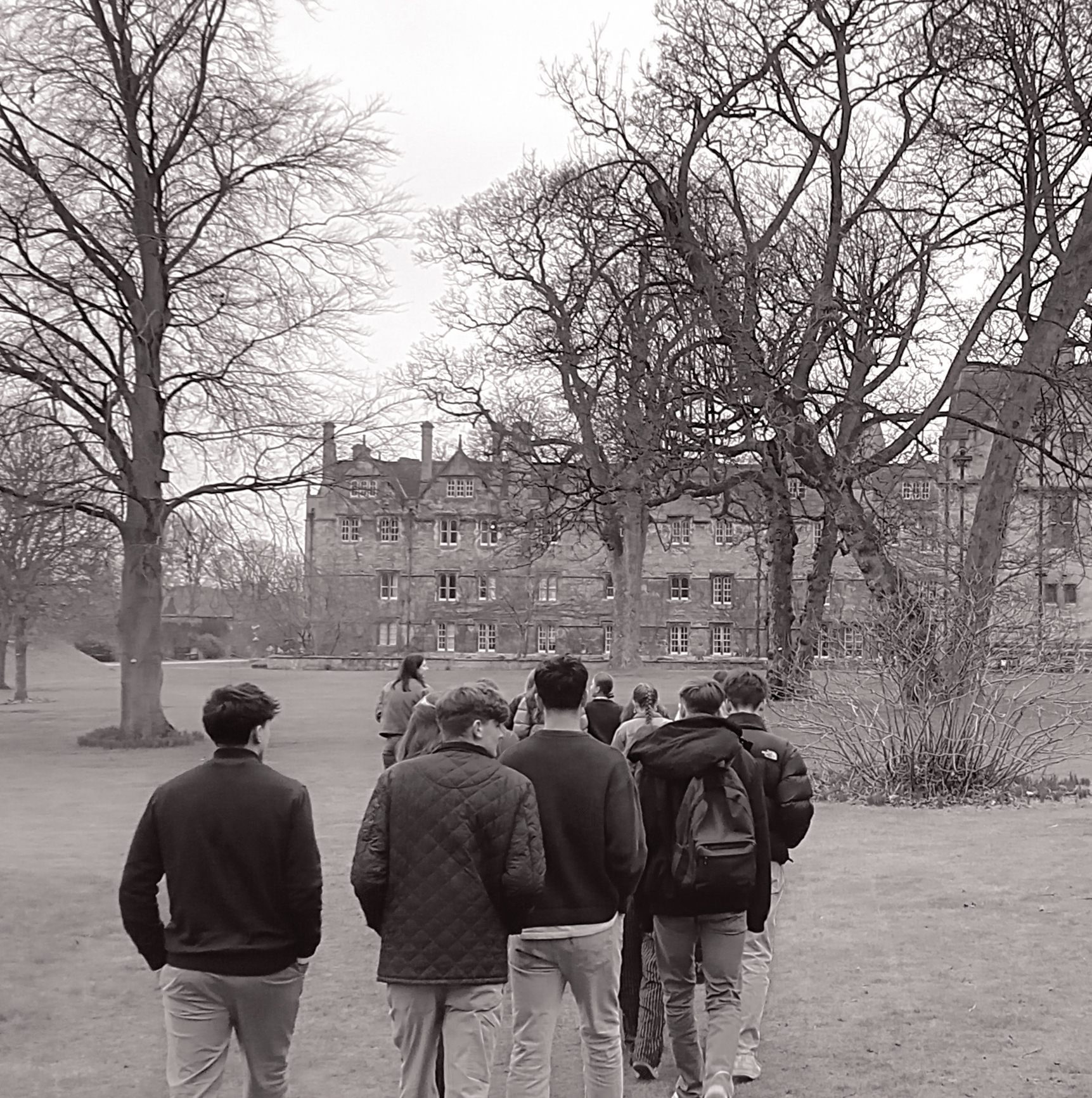
Enrichment and Leadership
Our Enrichment Programme supports students in developing independence, creativity, and leadership. It includes:
- Clubs and Societies
- Outreach activities
- Duke of Edinburgh Award
- Debating and public speaking
- STEM and media sessions
- Games and wellbeing activities
A core expectation of Sixth Form life at Gillingham is student leadership.
All students are encouraged to take on responsibilities that positively shape our school community—whether through formal roles, student-led campaigns, or mentoring initiatives. We expect our students to model ambition, pride in achievement, kindness, tolerance, and mutual respect.
Subject Option Blocks for Year 12
Students may choose a maximum of one subject from each block and must select a minimum of three subjects overall. In addition to their chosen subjects, all students will be timetabled into one of the Independent Study rooms as part of their programme of study.
| Block P | Block Q | Block R | Block S |
|---|---|---|---|
| Biology | Art | Business BTEC | Chemistry |
| Business | Biology | Chemistry | Economics |
| Criminology Diploma | Business | Criminology Diploma | English Language |
| Economics | Computer Studies | English Literature | English Literature |
| Geography | German | French | Geography |
| Physics | Law | Further Maths | History |
| Politics | Mathematics | History | Music |
| Psycology | Media Studies | Law | Photography |
| Spanish | Psycology | Mathematics | Physical Education |
| Theatre Studies | Sociology | Product Design | Product Design |
| Sports BTEC | Psychology | Sociology | |
| Textiles |
Sixth Form Subjects
We offer a wide range of over 30 Sixth Form subjects taught by subject specialists, as well as complementary courses in Core Maths and the Extended Project Qualification, which will support you with your A Level subjects, and applications for future pathways.
We are pleased to offer A Level Sociology, and from September 2026 will be offering Criminology A Level and a T Level in Digital Software Development.
Sixth Form A-Z Subjects
Art… it should be right there right up in the front because I think art teaches you to deal with the world around you. It is the oxygen.
Alan Parker, filmmaker
The course explores varied ways of drawing, printmaking, painting, creating sculptures and using digital and darkroom photographic techniques. As the course develops, students have increasing independence regarding themes studied and materials they explore. They are encouraged to have a creative curiosity about diverse historical and contemporary artists practices, and the way they can, as individuals, respond to the world that surrounds them. Many students tailor their work to their specific interests and this results in a rich creative environment.
Students need to be curious, motivated and resilient. Assessment of skills is focused on four areas: developing work in response to artists, exploring materials, recording ideas and responses, and then a personal response.
The Photography A Level teaches you how to examine the world through a lens, working with both technical and artistic elements. Students investigate digital and darkroom processes and varied forms of digital and physical editing. They also have the opportunity to use sculpture, textiles or fine art based techniques in their work. As the course develops students have increasing independence regarding themes studied and the materials they explore. They are encouraged to have a creative curiosity about diverse historical and contemporary photographic practice and the way that art influences Photography. Photography A Level can also encompass film and moving images if students have an interest in these areas.
Students need to be curious, motivated and resilient. Assessment of skills is focused on four areas: developing work in response to artists and photographers, exploring materials, recording ideas and responses, and then a personal response.
A level Biology explores the theories and principles involved in living systems in all their sophisticated beauty. You will learn about lifestyle, transport, genes and health, development, plants and the environment, the natural environment and species survival, energy, exercise and co-ordination, as well as practical biology and research skills. You will gain a clear understanding of how humanity makes conclusions about scientific issues, as well as some of the ways in which the scientific community contributes to the success of the economy and society.
A Level Biology is a challenging, but highly rewarding subject to study. The skills required to be successful are plentiful, but having strong skills in analysis and problem-solving is a good start. You will also need to be highly organised, show good time management skills and be able to work effectively independently. Strong mathematical skills are also highly recommended for those who study A Level Biology due to the increased frequency of numerical questions.
The Business department seeks to equip students with the skills they will need in whatever organisation they are a part of in the future. These range from team communication and collaboration to financial understanding, marketing and the ability to analyse and dissect different businesses in order to make judgments and recommendations. The Business A level brings the subject up-to-date, enabling students to engage with, explore and understand business behaviour and develop a critical understanding of what business is and what it does.
Having a keen interest in Business is integral to studying this course. Many students study Business across the world and, as a popular subject, the competition for exciting and fulfilling jobs is intense. You will need to have an outstanding work ethic and work hard to stand out.
Those who enjoy hands-on, practical work with plenty of real life situations tend to find stimulation and success through studying for a BTEC Level 3 National Extended Certificate qualification which is equivalent in size and study hours to one A Level. This qualification is for students who are interested in learning about the business sector alongside other fields of study.
This course is ideal for students who are passionate about business and are either planning on starting up their own business or pursuing a career in business. The course will suit you if you prefer coursework to exams and want the chance to carry out a detailed investigation of different businesses. You do need to be able to cope with constant and tight deadlines, so organisation is very important. There is a significant element of reading and writing because of the coursework, but also an expectation that students discuss and question at every opportunity.
A-Level Chemistry delivers a comprehensive look at the world around us. It touches every aspect of our lives from the bodily functions within us to the atmosphere. This course is for students who want to understand this and the physical universe better.
Through chemistry we can describe and explain questions such as:
- “what happens when sugar dissolves in tea?”
- “why is mercury a liquid at room temperature?”
- “how do we make plastics?”
- “what can we do about global warming?”
The course will also ensure that you develop independent study skills, familiarise yourself with experimental techniques, and will provide you with an established understanding of Chemistry if you wish to continue studying it beyond A Level.
A Level Chemistry is a challenging, but highly rewarding subject to study. If you like logical problems and thinking hard, then Chemistry is for you. You will need strong mathematical and numerical skills. You will also need skills in analysis and problem solving, time management and organisation, recording and monitoring data and teamwork.
An A level in Computer Science encourages students to develop an understanding of, and the ability to apply, the fundamental principles and concepts of computer science, including abstraction, decomposition, logic, algorithms and data representation. It will teach how to analyse problems in computational terms through practical problem solving experiences, including writing programs. The course will build the capacity to think creatively, innovatively, analytically, logically and critically, alongside the ability to see relationships between different aspects of computer science. Students will develop their mathematical skills and learn to articulate the individual (moral), social (ethical), legal and cultural opportunities and risks of digital technologies.
To be successful, students need good mathematical skills, an ability to think logically and analytically and a problem-solving mentality.
AS Level Core Mathematics is diverse, engaging and highly useful in supporting students who need essential problem solving and quantitative skills to support their other qualifications, or for future study and employment. The course is intended for students who have passed GCSE Mathematics at a grade 4 or higher, but who have not chosen to study A Level Mathematics. It is taught across one year with the exam taken towards the end of Year 12. Each paper requires the use of preliminary material, which the students become familiar with prior to the exam.
To aid the transition from GCSE to AS Level Core Mathematics, we recommend that you are fluent in calculating percentages, using the equation of a straight line, finding averages and understanding a range of diagrams. The course is delivered so that there is little homework set, other than one marked assignment per topic, and revision prior to the exams.
A Level Criminology offers an engaging and thought-provoking exploration of crime and criminal behaviour. The course explores the causes, consequences, and prevention of crime. Students examine theories of criminal behaviour, the role of the criminal justice system, and how laws are made and enforced. They will study the social, psychological, and legal aspects of crime, encouraging students to question why people commit crimes, how society responds, and what can be done to prevent offending.
The course combines elements of psychology, law, and sociology, encouraging critical thinking and analytical skills. It also encourages independent research and evidence-based argumentation.
A Level Criminology is ideal for students interested in careers in law, policing, forensic science, social work, youth justice, or criminology. It provides a strong foundation for further study in related fields at university or entry into a wide range of public service roles.
Fashion & Textiles is an inspiring, rigorous and practical subject. Pupils will combine creativity, imagination and technical skill to develop and modify designs, aiming to produce products with a unique style. The specification enables learners to identify market needs and opportunities for new products, initiate and develop design solutions, and make and test prototypes. Students should acquire subject knowledge in Fashion & Textiles, including how a product can be developed through the stages of prototyping, realisation and commercial manufacture. The course provides an opportunity for students to integrate and apply their understanding and knowledge of other subject areas studied during key stage 4, with a particular focus on Science and Mathematics.
Students are required to be organised, have good time management skills and be able to meet deadlines for extended pieces of work. Alongside having an ability to think creatively to solve a range of problems, they should be able to effectively communicate key design ideas to others. A real interest in fashion, textile products and design in general is essential.
*Please note this course cannot be studied alongside Product Design
Design and Technology is an inspiring, rigorous and practical subject. Students will use creativity and imagination when applying iterative design processes to develop and modify designs, and to design and make prototypes that solve real world problems. The specification enables learners to identify market needs and opportunities for new products, initiate and develop design solutions, and make and test prototypes. Learners should acquire subject knowledge in Design and Technology, including how a product can be developed through the stages of prototyping, realisation and commercial manufacture. Students should take every opportunity to integrate and apply their understanding and knowledge from other subject areas studied during key stage 4, with a particular focus on science and mathematics.
Students are required to be organised, have good time management skills and be able to meet key deadlines for extended pieces of work. You will need to be able to think creatively to solve a range of problems and be able to communicate key design ideas with others. You should have an interest in resistant materials and workshop practice, as well as in cross-curricular links such as Mathematics and Science.
*Please note this course cannot be studied alongside Product Design Fashion and Textiles
T Levels in Digital Software Development offer a powerful blend of academic knowledge and hands-on industry experience, making them an excellent choice for students interested in digital careers. This qualification equips learners with in-depth skills in areas such as software development, data analysis, and digital project management, all while working closely with real employers through extended industry placements. As a result, students gain not only technical expertise but also valuable workplace experience, boosting their employability and readiness for roles in the fast-evolving tech sector. Additionally, T Levels provide a strong foundation for further study, including higher apprenticeships or university degrees in digital and computing fields.
From September 2026
It does not matter if you have not studied Economics before. You might have an interest in economics and want to know more about the impact it has on the world around you. You might want to investigate some of the stories you hear in the news – Why do some economies grow and others do not? Why did economists fail to predict the Global Financial Crisis? What impact does the economy have on the business world? This course will help you to understand all this and more.
A level Economics requires logical thinking, and a command of Mathematics to a good GCSE level. It is also a subject which requires social awareness and which develops the ability to debate, both in class and on paper. There is often no right or wrong answer when it comes to Macroeconomics and you therefore need to be able to present arguments clearly, supported by relevant examples.
A Level English Language offers a wide-ranging introduction to concepts and methods of the disciplines of English language/linguistics in relation to a diverse range of spoken and written forms of English, including electronic and multimodal forms. The course covers a range of terminology as part of the language levels, and you learn how to apply both your prior and new knowledge to the texts we find in our everyday lives. We consider language from a psychological and social perspective as well as unpicking the ‘nuts and bolts’ of grammar and spelling.
You need to be interested in language and how it works, how we use it, why we use it the way we do and how it has changed to get the most out of the course. Reading and listening to language all around you is a key part of helping you to understand it. You will be encouraged to develop and apply your understanding of the concepts and methods appropriate for the analysis and study of language. You will explore data and examples of language in use. You will need to engage creatively and critically with a broad range of texts. You will develop your skills as a writer and analyst of language. You will need to independently investigate language in use.
English Literature is a rich and fascinating course that brings you face to face with some of the most important and amazing literature ever written. It is a highly respected academic course which offers an excellent training for university courses. You will read a wide range of texts and learn to interpret them in different ways, covering topics such as psychology, history, politics, sociology, aesthetics, gender, race, sexuality and many others – anything, in fact, that makes us human.
You will develop sophisticated reading and writing skills and you will need to read and write independently. You will need to research topics outside of the classroom. There is a particular focus on essay writing: you will learn to order your thoughts logically, use evidence effectively and build an argument. These are skills that are invaluable when embarking upon higher level studies or careers.
Following an EPQ presentation in the Autumn Term of Year 12, students will be able to indicate their interest in undertaking an Extended Project Qualification. They will have dedicated Taught Skills lessons and work with an EPQ Supervisor who will support them throughout the process giving feedback and guidance and can have additional assistance from a Mentor who is
knowledgeable about the student’s chosen area. Taught Skills lessons will be included in students’ timetables from December and Supervisor lessons will be timetabled from January.
An EPQ is worth half the UCAS points of a full A Level or BTEC Level 3 qualification and is well regarded and accepted by the majority of universities, apprenticeship providers and employers as it demonstrates an ability to independently take a project from the conceptual stage through to a final product and presentation. As such, it will incorporate and develop many invaluable
transferable skills. The project can take many different forms, from an academic piece of writing looking into an area of interest, to a creative project such as building a guitar, to organising and running a fund-raising event or exhibition. In each case, the way the project is planned and executed is closely monitored and assessed.
To carry out an EPQ, students need, above all, to be enthusiastic and motivated to work independently on their project. Good organisational and time management skills are essential, as is attention to detail and an enjoyment of research.
A level French introduces students to how French speaking society has been shaped socially and culturally and how it continues to change. The content is suitable for students who wish to progress to employment or further study, including a Modern Languages degree. As part of the course, students will also have the opportunity to study a French film and a French novel and to
research an area of French culture, society, literature or film which is of personal interest. Students will cultivate their knowledge and understanding of themes relating to the culture and society of countries where French is spoken.
The A Level course will build on the knowledge and abilities gained at GCSE and requires a range of transferable skills including communication, critical thinking, research skills and creativity, all of which are invaluable to the individual and society. You will need to be focused on developing your language skills in listening, reading, speaking and writing through authentic written and spoken sources in French.
A Level Further Mathematics is an added layer to the content covered in A Level Mathematics. You cannot study A Level Further Mathematics without studying A Level Mathematics first. At Gillingham School, all the students who choose to study A Level Further Mathematics are placed in one class, and taught both A Level Mathematics and A Level Further Mathematics together
at an accelerated pace. Previous students have enjoyed the challenge of such a stimulating learning environment. The emphasis throughout the course is again on the development of mathematical argument, language and proof, mathematical problem solving and mathematical modelling, with the use of technology permeating the teaching and learning.
A Level Further Mathematics builds on the skills, knowledge and understanding developed through previously studying A Level Mathematics. Assessments will be designed to reward students for demonstrating the ability to provide responses that draw together different areas of their knowledge, skills and understanding from across the Mathematics and Further Mathematics courses. Problem solving, proof and mathematical modelling will be assessed in the context of the wider experience gained from studying Further Mathematics.
A Level Geography offers a selection of new, interesting topics not covered at GCSE level, and allows students to go into greater depth in some key elements previously studied. It covers both the physical and human environments and the complex interaction of processes that shape our world. It will also, importantly, show the applied side of the subject – how human intervention affects the environment and how people adapt and mitigate the effects of processes on their environment. There is plenty of room for discussion and extended research, which will help you to become an independent thinker and learner. By the time you get to your exams, you will be able to show your understanding of a range of opinions and be able to illustrate your answers with case studies from local, national and international examples.
You will learn in a wide variety of ways, using maps, GIS skills, data analysis, photos and videos. You will be encouraged to frame your own questions using higher level thinking and evaluative skills and show your grasp of complex issues through essay writing. Fieldwork will be an essential part of your A Level course.
A Level Government and Politics helps students to gain a wider understanding of the structures, institutions and thoughts that underpin contemporary UK government and politics. In addition, students learn about US government and politics allowing them to make comparisons and draw analytical conclusions.
Throughout the course students will be exposed to a wide range of debates and they will develop confidence in
demonstrating evidence based argument.
Students do not require an in depth knowledge or prior learning with regard to government and politics. They must however have an inquisitive nature, a desire to understand the nature of UK government and politics and a growing interest in current affairs. Analytical skills are developed through the course and students increasingly evaluate standpoints, political argument and institutions. The course also lends itself to those who are seeking to develop their oracy. Such skills provide an excellent base for those going on to higher education or into the world of work.
A level History is made up of a diverse range of units providing a broad base of British, European and Russian History which should appeal to any student with an interest in this subject. Studying History teaches key skills such as developing your own opinions and formulating well-reasoned arguments. You will also develop skills in independent research, debating, writing and
analysis. You will be able to make links between the past and current society, and gain an understanding of how political, social and economic developments have informed our lives today. With an emphasis on written communication, personal research and discussion, History A Level will help you to develop a range of important skills for the future.
A passion for the subject, a willingness to engage in discussion and debate, as well as questioning accepted historical viewpoints. The ability to organise yourself to meet deadlines and undertake independent research. Reading a range of texts will be essential for success in this subject.
Studying A Level Law aims to give you an understanding of the role of law in today’s society and to raise your awareness of the rights and responsibilities of individuals. By learning about legal rules and how any why they apply to real life, you will also develop your skills in critical analysis, decision making and problem-solving. All these skills are highly sought after by higher education establishments and employers.
To study A Level Law, you will need to have a real interest in the subject and a willingness to engage in discussion and debate. You will need to be organised, hard-working and ready to commit key fundamentals of law to memory in order to apply them to case studies.
A Level Mathematics builds upon GCSE Mathematics to give you the opportunity to study topics such as geometry, calculus and trigonometry, alongside statistics and mechanics, and represents a strong base from which to study Mathematics or a mathematically related degree at university. The emphasis throughout the course is on the development of mathematical argument, language and proof, mathematical problem solving and mathematical modelling, with the use of technology permeating the teaching and learning.
To aid the transition from GCSE to A Level Mathematics, we recommend that, prior to starting the course, you are fluent in simplifying, expanding, factorising, and rearranging algebraic expressions, as well as in solving both linear and quadratic equations. The use of sketching is also a very important tool which can help simplify a written mathematical problem. From
geometry in pure mathematics to mathematical modelling in mechanics, a sketch will help you to make sense of problems which look challenging in written form and therefore we recommend you also develop this skill prior to starting the course.
A Level Media Studies will help you to explore the profound impact media has on society, culture, and communication. The course will develop your critical thinking skills to analyse and deconstruct various media forms, including film, television, advertising and digital media. Through discussion, essay writing and practical media making, you will learn about Media Language, Audiences, Industries and Representations. The course can be quite political, as you consider and critique the different responses which media might provoke in an audience. A Level Media Studies empowers you to become a discerning media consumer, producer, and scholar, preparing you for a future in media-related fields, or for life as a well-equipped citizen in a media-saturated world.
A Level Media Studies requires skills in critical analysis, communication, and creativity. Students need to analyse media texts, understand their cultural and social implications, and express their ideas effectively in written and oral form. Additionally, skills in research, media production and technology may be beneficial. Being able to evaluate media content critically, engage with theory, and demonstrate a nuanced understanding of media industries is also essential for success in this subject.
A Level Music opens up a world of music through the detailed study of a diverse range of pieces and songs. You will study the history of music (from the renaissance period through to the present day) and the principles of composition, along with developing your practical ability. You will develop analysis skills that allow you to see how music works and link this to the music which you listen to, compose and perform. As well as those who enjoy being creative with performance and composition, it is also for those who enjoy the intellectual rigour of research and analysis, whilst also developing skills in essay writing and critical thinking.
All students are required to be learning an instrument; individual tuition and practising regularly at home is recommended, as well as taking advantage of performing opportunities both in and outside of school. Students must be open to exploring different genres of music. As well as meeting the entry requirement, we would expect students to have a good knowledge of music theory, excellent time management skills and to show commitment to their musical studies.
The Music Technology course is for anyone who has a deep affection for music and how it is produced. The course consists of engaging practical content, which will equip students with skills for higher education and beyond. The course can be taken alongside the A Level Music course and can be an extremely rewarding creative outlet.
Over the duration of the two year course A Level Music Technology students will develop cognitive skills such as creativity, problem solving, decision making and analysing, synthesising and reasoning. Students are expected to compose and produce their own music inside and outside of school to help refine their skills and actively listen to a wide range of past and contemporary
music to form the foundation for their understanding.
A Level Physical Education delivers a well-rounded and full introduction to the world of PE, Sport and Sports Science, providing a strong base from which to move on to higher education, employment or further training. The emphasis throughout the course is on the development of knowledge, application of knowledge, competence and confidence in a wide variety of skills. You will learn how Physical Education affects and contributes to society and also how to apply your knowledge from this course to any number of different practical situations or career choices.
A Level PE students develop the ability to demonstrate knowledge and understanding of physical activity, and to apply this to a range of sporting contexts. Analytical and evaluative skills are developed through both written and oral responses. There is also an increase in the amount of scientific study, together with the inclusion of data analysis requiring mathematical skills. Students are expected to be playing sport in and outside of school on a regular basis.
A level Physics gives you the chance to explore the wonders of the universe and to look at theories that explain what is observed. As a physical science, there is an emphasis on predicting behaviour and testing through observation and measurement. The course combines practical skills with academic ideas to develop descriptions of the physical universe. So, if you want to be able to explain where you derived from or where you are going then this is the course for you. Many employers list Physics as one of the most esteemed A Levels available.
A Level Physics is a demanding, but highly rewarding subject to study. You will need incredibly strong analytical and problem solving skills. To achieve a good grade, you will also need to possess strong independent working skills as well as good time management and organisation. Physics also relies on strong mathematical skills and, as a result, complements Maths A level very
well. A strong mastery of basic trigonometry, geometry, and algebra is required at the very least.
Psychology is a broad subject, covering topics that overlap with many other disciplines. At times, studying Psychology looks and feels like a Natural Science, for example when studying the structure and function of the human nervous system or the way neurotransmitters work. At other times it overlaps with subjects within the Arts, such as Media Studies (for example, looking at
the process of social learning and the impact of role models), PE (for example, studying the processes involved in conditioning), Business Studies (for example theories of motivation) and even English Literature (for example, looking at Freudian concepts or theories of gender). This course will teach you that human behaviour is complex and it will encourage you to seek to understand, rather than to judge, others.
A level Psychology suits people who are all-rounders. You will need to express yourself in written responses that could carry up to 16 marks (around 20 minutes of writing), so you will develop concise essay writing skills. You will need to be willing to handle data (for example, calculating percentages, drawing graphs and interpreting statistics), so you need to be willing to continue your journey with basic mathematics. You will also be thinking critically about the validity of research studies, so you will be thinking like a scientist about variables, control and reliability. Above all, Psychology lessons require you to be an active participant. There will be lots of paired and class discussion, games and activities, all designed to help you lay down secure long term memories.
Sociology is an exciting and relevant A Level subject which focuses on the study of social life and how our environment shapes our futures. Considering how society is organised and how humans experience their lives helps students to understand and think critically about why our world is the way it is. All students will study a range of sociological research methods as part of the course. Some of the questions and topics that students can expect to explore might include:
• How are family life, relationships, households and traditional roles changing?
• How are different social groups represented in the media? How is representation of ethnicity, gender, sexuality, social class and age changing?
• What are the patterns and trends in crime, and how can this be explained and reduced?
• What is the role of education in society, and how can inequality, different experiences and achievement be explained?
• What is the role of religion, faith and belief in contemporary society?
• What are the main patterns and trends in social inequality and difference (gender, social class, and ethnicity) and how can they be explained?
• What are youth subcultures and how do they form?
• Why are there inequalities in physical and mental health, and access to health services, globally and in the UK?
• What is the relationship between digital communication and globalisation?
• Why do countries and regions develop at different rates? How have aid, trade, industrialisation, the environment and war contributed to this?
Sociology is the study of human social activity, relationships and social structures. You will be required to use critical and analytical thinking skills to explore themes such as cultural competence and self-awareness. Sociology gives you a broad and diverse outlook on the world which is a valuable skill in the modern working world.
A level Spanish introduces students to how Spanish speaking society has been shaped socially and culturally and how it continues to change. The content is suitable for students who wish to progress to employment or further study, including a Modern Languages degree. As part of the course, students will also have the opportunity to study a Spanish film and a Spanish novel
and to research an area of Spanish culture, society, literature or film which is of personal interest. Students will cultivate their knowledge and understanding of themes relating to the culture and society of countries where Spanish is spoken.
The A Level course will build on the knowledge and abilities gained at GCSE and requires a range of transferable skills including communication, critical thinking, research skills and creativity, all of which are invaluable to the individual and society. You will need to be focused on developing your language skills in listening, reading, speaking and writing through authentic written and spoken sources in Spanish.
The BTEC Level 3 National Extended Certificate is equivalent to one A Level. It is designed for learners who are interested in learning about the Sport and Exercise sector.
Analytical and evaluative skills are developed through both written coursework and external exams. Students will need to meet regular deadlines and work well independently on set tasks in order to succeed on the course.
The qualification emphasises practical creativity alongside research and theoretical understanding. Students learn through experience, seeing theatre and making theatre for themselves. They are introduced to a wide range of theatrical styles and contexts as they explore plays practically, and devise and work on performances. Students can choose to develop as a performer, designer (lighting, sound, set, costume, puppets) or director. Whichever option they choose, students will gain many invaluable skills, both theatrical and transferable, to expand their horizons.
Drama students are expected to be able to adapt to working individually, in a pair or as a member of a group, and to be able to support (and work with) those around them, regardless of background. We will also expect them to be increasingly independent and able to plan, monitor and reflect on their work, and the work of others (both within school and externally) Our Drama students are expected to give of their time generously through their attendance of theatre visits and extra scheduled rehearsals for performance exam work. We would also expect our students to want to get actively involved in the extra-curricular life of the department through, for example, school productions, Creative Arts Awards evenings, acting as Drama Ambassadors and assisting with lower school Drama lessons.